
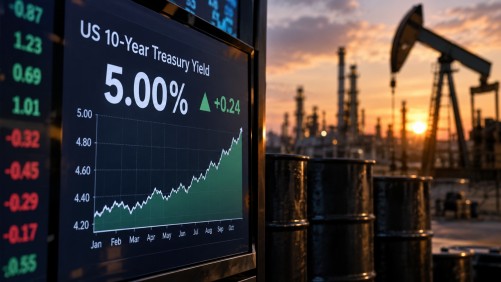
The cost of borrowing for the US government has climbed to 5% for the first time since 2023, driven by a significant sell-off in the global bond markets. This development comes amid escalating oil prices and rising concerns about inflation. On Monday, the yield on the 10-year US Treasury bond, a key benchmark, hit the crucial 5% threshold. Earlier this year, the yield had dipped to around 4% but has been on an upward trajectory since the US-Israeli conflict with Iran erupted in late February. The last time yields were at these levels was in October 2023.
This uptick in bond yields coincides with Brent crude, the global oil benchmark, surpassing $108 a barrel. The surge in oil prices follows attacks on Saudi Arabia’s energy infrastructure and mounting tensions in the Middle East. A series of drone strikes forced Saudi Arabia to close a critical east-west pipeline, sparking fears about potential disruptions to the global oil supply. Complications have intensified due to attacks linked to Iran-supported Houthi forces and growing unease surrounding the Bab al-Mandab Strait.
Adding to the complexity, Gulf nations have delayed discussions with Tehran regarding a temporary shipping route through the Strait of Hormuz, a vital passage for a significant portion of the world’s oil and gas transport. The escalation in energy prices is exacerbating inflationary pressures and contributing to uncertainty over the future path of global interest rates. Investors are closely monitoring the upcoming interest-rate decision by the US Federal Reserve, with the Bank of England also poised to announce its decision later this week.
The rise in US Treasury yields holds considerable implications for global financial markets, as the 10-year Treasury serves as a key benchmark for borrowing costs. Higher yields can escalate financing expenses for governments, businesses, and households worldwide. Similarly, bond yields have increased across Europe, with long-term UK government borrowing costs hitting their highest in decades. The combination of rising energy costs and renewed geopolitical tensions raises concerns that central banks might have to maintain tighter monetary policies for an extended period.
Throughout the year, oil prices have exhibited significant volatility. Brent crude surged from approximately $72 a barrel before the conflict to a peak of around $126 in April, then eased during the summer amid hopes of a lasting ceasefire. However, prices have risen again as hostilities have intensified and diplomatic efforts have faltered. With oil prices once more exceeding $100 a barrel, markets are grappling with renewed fears over inflation, interest rates, and the broader impact of sustained disruptions to global energy and trade routes.